Children · 4 min read
Children's hair care: braiding, detangling and no relaxers
Doctor review pending
Gentle routines for children's curls, and why tight styles and relaxers can harm young scalps.
At a glance
- What it isChildren's hair is finer and their scalp more delicate than adults'
- CausesChildren's hair is finer and their hairlines are fragile, so traction damage starts early
- What helpsMoisturise with a light, fragrance-free leave-in
- AvoidAvoid chemical relaxers and texturisers in young children, styles that cause pain or bumps
- On darker skinTight braids, cornrows and extensions are common in Nigerian children and are a leading cause…
- See a doctor ifSee a doctor for patches of hair loss, scaly scalp (possible ringworm)
Key points
- If braiding hurts, it is too tight.
- No relaxers for young children.
- Scaly patches with hair loss may be ringworm.
What it is
Children's hair is finer and their scalp more delicate than adults'. Good hair care keeps hair moisturised and avoids damage to the edges and scalp.
How it works
Children's hair is finer and their hairlines are fragile, so traction damage starts early.
Why it matters on darker skin
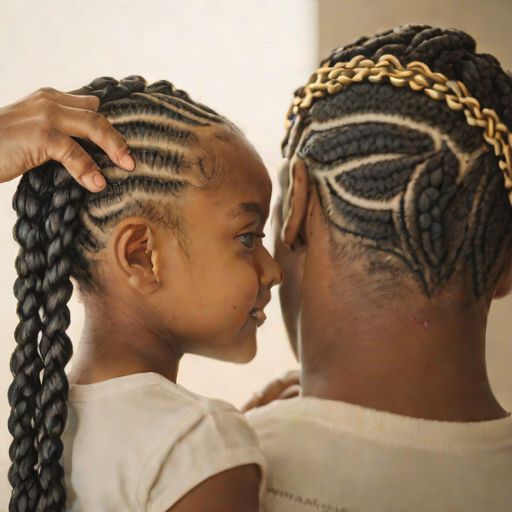
Tight braids, cornrows and extensions are common in Nigerian children and are a leading cause of traction alopecia starting in childhood. Chemical relaxers can burn young scalps.
Causes and triggers
Tight braids, extensions, relaxers.
What helps — and why it works
Detangle gently with conditioner and fingers or a wide-tooth comb, working from ends to roots. Moisturise with a light, fragrance-free leave-in. Choose loose braids or twists without heavy extensions, keep styles in for no more than a few weeks, and give rest days. Wash every 1 to 2 weeks, or more often if the scalp is flaky. Loose styles, short durations: protect hairline. Expected timeline: ongoing. Gentle detangling with conditioner: reduces breakage. Expected timeline: immediate.
What to avoid and why
Avoid chemical relaxers and texturisers in young children, styles that cause pain or bumps, beads that pull, and adult hair dye.
Common mistakes
- Relaxers.
- Very tight braids for school.
Caring for children's skin
Children's skin is thinner, loses water faster and absorbs more of what is applied to it relative to body size, so simpler is safer. For most children a short lukewarm bath, a fragrance-free soap substitute and a plain emollient are all that is needed, plus shade, clothing and sunscreen from six months of age. Avoid adult products, essential oils, antiseptics in bath water, bleaching or 'toning' creams, and cosmetic treatments such as relaxers and gel nails. Medicines and medicated creams should be used only as a doctor, nurse or pharmacist advises, and in children Melanin & Me does not offer photo checks: a clinician should see the child. Trust your instincts as a parent: a child who is unusually sleepy, floppy, not feeding, breathing fast or has a rash that does not fade when pressed with a glass needs urgent care. Keep a simple record — photos and dates — of rashes that come and go, as this helps the doctor.
Products, medicines and when to worry
When choosing products for children, look for fragrance-free formulas with short ingredient lists, and avoid adult acne, anti-ageing or lightening products, essential oils and talc. Medicated creams — including steroid creams, antifungals and antibiotics — are safe and helpful when prescribed for the right condition and used for the right length of time, but mixed creams sold over the counter can contain strong steroids that are unsafe for children. Sunscreen is suitable from six months of age; younger babies should be kept in the shade and covered. Do not give medicines intended for adults, and ask a pharmacist about the right medicine for a child's age and weight. Seek urgent care for any rash with fever and a very unwell child, a rash that does not fade under a glass, swelling of the face or lips, or blistering of the mouth or eyes.
Important
When to see a doctor
See a doctor for patches of hair loss, scaly scalp (possible ringworm), bumps along the hairline after braiding, or lice that will not clear.
Visit a hospital or clinic near you and ask to see a dermatologist (skin specialist), or ask your general doctor for a referral. Take this page and the products you use with you. Emergency: call 112.
Questions to ask your doctor or pharmacist
Useful questions include: What do you think is causing this? Is it likely to come back, and how can I prevent it? Which products should I stop? How long before I should expect improvement, and when should I come back if it isn't better? Are there side effects to watch for? Is this treatment safe if I am pregnant, breastfeeding or for my child? Writing your questions down, bringing your products (or photos of their labels) and taking dated photos of the problem make an appointment much more useful.
Sources
How to read this article. This article explains general principles, based on guidance from organisations such as the NHS, NICE, the American Academy of Dermatology, DermNet and the WHO. It cannot account for your own medical history, medicines or pregnancy, and it is not a diagnosis. Where we mention treatments we do not give doses: a doctor or pharmacist will advise on what suits you. Timelines are typical, not guaranteed — everyone's skin, hair and nails respond at their own pace.
Source links checked 2026-10-12. Doctor review pending. Education only, not a diagnosis. Ask a doctor or pharmacist before starting treatment.
Related articles
Children · 4 min read
Scalp ringworm (tinea capitis)
A fungal infection that causes scaly patches and hair loss, common in children.

Children · 4 min read
Eczema in babies and children
Dry, itchy patches in little ones: a calm, practical plan for parents.
Children · 4 min read
Cradle cap
Greasy yellow scales on a baby's scalp are harmless and gentle care is enough.